|
|
 |
 Product information > Automatic multi-layer welding robot Product information > Automatic multi-layer welding robot |
 |
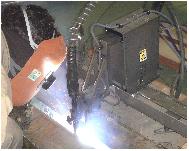
| When welding back plate grooves of various steel structures, the number of welding passes increases by great amount when the welding target’s thickness is too thick. It results in longer welding period as well as increased number of defects. Since the need of welding of thick steel plates is increasing evermore in the ship construction industry, there is a need for a device that can satisfy them all. Our multi-layer automatic welding device is an adequate device that can weld thick steel plates that require multi-layer welding using welding joints. It is equipped with automatic welding function that detects the plate’s thickness and form to automatically calculate the optimal welding starting/ending point. It also uses its own touch probe sensor to automatically remember and track the welding line in order to minimize user management during the automatic welding process. Also, welding conditions may be changed for each joint gap’s condition in order to provide consistent welding beads with high quality.
|
 |
| NO |
Category |
Specifications |
Remarks |
| 1 |
Applied welding technique and for |
CO2 welding, downward facing welding |
 |
| 2 |
Range of application |
Max. thickness 100mmt, Gap max 25mm
Minimum of 25 degrees of improvement |
| 3 |
Device movement method |
Upper rail movement, rack-pinion movement |
| 4 |
Weight |
App. 7.5 KG (Robot body) |
| 5 |
Input power |
AC 220V |
| 6 |
Major control device |
Embedded PC |
| 7 |
Robot communication method |
CAN communication |
| 8 |
Composition |
Robot + Robot car + Rail + Control box +
Control pendant + cable
|
|
 |
| Classification |
Category |
Specifications |
Remarks |
| robot |
Number of movement axis |
4 axis (movement, vertical, forward-backward, torsion) |
|
| Movement speed |
0 - 1,500 MM/MIN |
|
| Detect form |
Automatic detection using touch sensors |
|
| Welding line tracking method |
Automatic creation of welding line using touch sensors |
|
| Create welding condition |
Automatic creation based on detected form (thickness, gap, improvement angle) |
|
| Robot and pendant communication method |
CAN communication (Four Robot connection cables) |
|
| Torch vertical adjustment |
LM + ball screw, distance 100MM |
|
| Torch forward-backward adjustment |
LM + ball screw, distance 80MM |
|
| Torch angle adjustment |
Harmonic decelerator applied, ±30° |
Zero cost |
| Major functions |
CAN communication |
Since CAN communication is used between control box, robot and pendant, four control cables are needed |
|
| Electricity fail protection function |
Able to recall existing data upon electricity failure. Able to continue with work after recovery. |
World’s first |
| Automatic creation of welding condition |
Able to automatically create welding current, voltage and speed based on thickness of improvement angle |
|
| Automatic tracking of welding line |
Automatic tracking of welding line after touching the starting/ending point |
|
| Gap compensation |
Automatic adjustment of weaving width and welding speed based on gap changes |
|
|
|